

A website on its own is invisible.
Having a website does not make anybody aware that you exist. It is a shop on a road with no signs to it: necessary, and on its own not enough. What actually brings people is the combination: search bringing the ones already looking, and marketing reaching the ones who do not yet know to look.
Five routes a stranger takes to reach you. Switch them off one at a time. What is left at the end is the point of this page.
- Search People already looking for what you sell
- Social People who were not looking, and now know you exist
- Listings and partners Council registers, trade bodies, suppliers, service directories
- Email Everyone you have already served, and every quote that went quiet
- Word of mouth Reviews and recommendations, which the others all feed
Your website
5 of 5 routes open
Five routes in. This is what a business people have actually heard of looks like, and every one of them is something that can be built rather than hoped for.
01 Social presence
The one or two platforms your customers are actually on, set up properly and posted to on a rhythm you can live with. We would rather you were genuinely good on one than absent on five.
02 Local authorities and registers
Council supplier lists, approved-trader schemes, chambers of commerce, trade bodies. Unglamorous places that carry real weight both with customers and with Google, and that almost nobody bothers to get onto.
03 Service providers and partners
The directories your industry actually uses, plus the suppliers and neighbouring trades who could be sending you work. Often the fastest route to enquiries in a market where nobody knows you yet.
04 Reviews
Asked for at the moment somebody is happiest, and replied to in writing. We do not buy, script or filter reviews, and we will not work with anyone who wants us to.
05 Email marketing
Every past customer, enquiry and quote pulled out of the inbox and the invoicing software and put somewhere usable, then a sequence that goes out whether or not anyone remembers to send it.
06 The follow-up
Quotes that went quiet chased properly, on a schedule, by something other than your memory. This is usually the fastest money in the whole engagement.
07 Advice for your trade
Not a generic playbook. What works for a wedding photographer and what works for a plant hire firm are not the same, and the plan is built around which one you are.
08 Measurement
First-time and repeat revenue reported separately, so the compounding half is visible instead of buried in one total.
09 Reporting
Monthly, written by a person, in English, including the campaigns that did not work and what is replacing them.
10 Ownership
The list, the accounts and the profiles are all in your name. It is your customer list; the idea that it could belong to an agency is how businesses get held to ransom.
Search only reaches people who already know they have the problem and are typing it into Google. That is a good crowd, and they are ready to buy, but it is only the people who thought to look, and only for the words they happened to use.
Marketing reaches everybody else. The ones who did not know a service like yours existed, the ones who will need you in eight months, and the ones who used you two years ago and have simply forgotten. Do one without the other and you are working with half a market.
They also feed each other. Reviews lift you in local search. People who saw you on social search your name later, and searching a business by name is the strongest signal there is that it is a real one.
- Search catches demand that already exists
- Marketing creates demand that does not yet
- Reviews raise you in both at once
- Being known makes ranking easier
- Ranking makes being known cheaper
- Neither of them needs you to be loud
The other half
What SEO is, in plain English, and what it does that this cannot.
Read about SEOMove the three sliders to your own business. Nothing is sent anywhere: this is arithmetic running in your browser, and it is a model, not a forecast.
First-time revenue
£192,000
What the marketing has to win from scratch, every year.
Repeat revenue today
£38,400
Earned from customers you already paid to acquire.
Ten points more repeat business
£19,200
A year, on the same spend, the same team and the same rankings.
Ten points is the number we aim at in year one. Whether it is reachable depends on what you sell and how often anyone needs it. A wedding photographer and a plant hire firm are not the same problem, and we will tell you which one you are before you spend anything.
I hate social media. Do I have to be on it?
Not necessarily, and not on all of it. For a lot of trades, the listings, the reviews and the email list do more than social ever will, and we will say so rather than sell you a posting schedule you will resent. Where social does matter, we run it, and you are not being handed a content calendar to fill in on a Sunday.
Can I not just do SEO and skip this?
You can, and for some businesses it is the right order: take the search demand first, add the rest later. But search only reaches people who already know to look for you. If your problem is that nobody in your area has heard of you, ranking for a term nobody types is not going to fix it.
What does it cost?
A monthly fee, quoted in writing after the audit, scaled to how many channels are genuinely worth running for you and how much content that needs. Rolling terms, a month's notice, and the number does not move without you agreeing to it first.
My customers only need me once. Is any of this worth it?
Then the work moves to referrals and reviews rather than repeat purchases: the same list, used to bring you somebody new instead of the same person back. What we will not do is sell you a monthly email programme for a business with no second sale in it.
What about GDPR?
We check the basis for every address before anything is sent, and we will drop the ones that do not have one rather than quietly mailing them. A smaller list you are allowed to contact is worth more than a big one you are not. We are not your solicitor, and for anything genuinely borderline we will tell you to ask one.
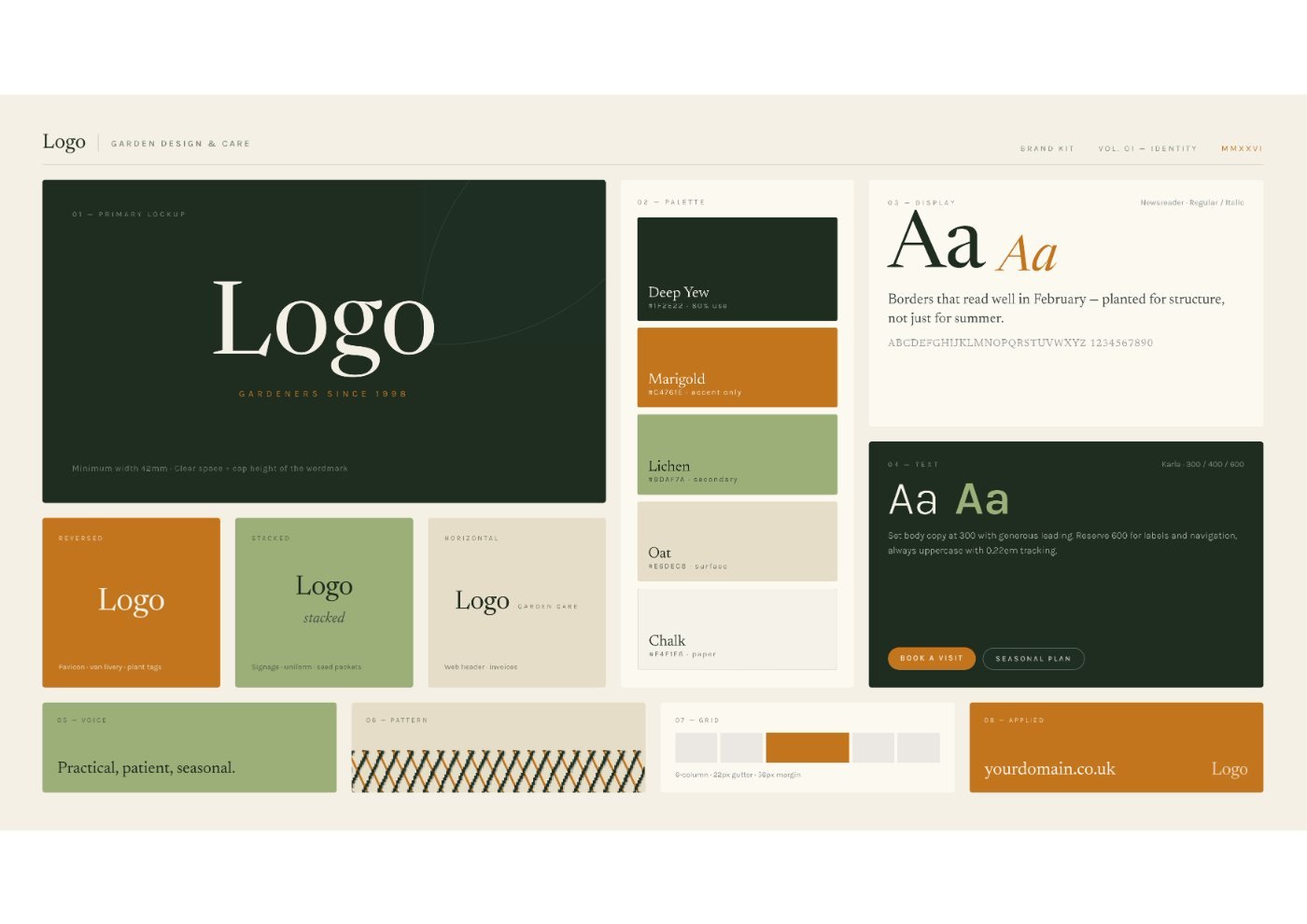
1 · Branding
Being seen five times only adds up to recognition if it looks like the same company each time.
How it works
2 · Website design and build
Every route above lands on a page. A slow one undoes the work of the message that got them there.
How it works
3 · SEO
The other half of the same job. Get ranked, get found, by the people already looking.
How it worksFind out which routes are open.
We will look at how somebody could actually find you today (search, social, listings, the list you already have) and tell you which of the five are shut. Free, and yours whether or not you use us.
Get my free audit